
New York City renters have dealt with numerous issues this year, from heat waves to historic low temperatures. For the third consecutive year in a row, 311 received the most complaints about mold from residents in the Bronx. While landlords do not have any effect on the weather, they do control the amount of moisture that is settled in their buildings.
Mold raises health concerns, such as headaches and itchy eyes, but in more serious cases, it can cause fungal infections that require diagnosis and treatment. Mold also damages property, as repeated instances indicate excessive moisture that could develop into unsafe structural issues. To find out how much New Yorkers combat mold issues, RentHop looked into 311 complaints about mold from 2017 through August 11, 2026. The results show that more renters have filed complaints about mold in recent years. Continue reading to learn if you live in an area with a high volume of mold complaints.
Key Findings
- The Bronx remains New York City’s moldiest borough, with 218.7 complaints per 10,000 residents.
- Flatbush receives the most mold complaints, averaging 642.8 complaints per year. An increase from last year of 19.2 from last year’s report.
- October 2023, specifically in Brooklyn, received the most mold complaints on record since 2017, coinciding with delayed effects of Tropical Storm Ophelia.
- Month-over-month, renters complain most about mold at the beginning of the year or in the late summer.
- Monthly complaints in 2026 are higher than 2025 at this point last year. This has been a higher humidity year than previous.
Mold Complaints by NYC Borough
The above chart breaks down the number of mold complaints by year by borough. The Bronx has received the most complaints yearly since 2019. Last year, the borough received 11,444 complaints, or 269.2 reports per 10,000 renter-occupied units, making it the moldiest borough in New York City.
Brooklyn is also a hot spot for mold complaints, where renters submitted 311 reports 10,046 last year. That’s 135.3 complaints for every 10,000 renters. Flatbush received the most mold complaints out of any neighborhood last year, and has already had 503 complaints in 2026.
With the exception of Manhattan, mold complaints decreased in 2025. With an increase in 311 awareness thanks to the mayor’s efforts, we are seeing more reported complaints this year compared to this time last year.
Mold Complaints, Mapped Out By NYC Neighborhoods
The interactive map below breaks down mold complaints to NYC 311 by neighborhood and highlights the top reported addresses. To fairly rank each neighborhood, we used raw complaint count from 2017 to 2026 by the total number of renter-occupied units. The darker the shade, the more complaints per 10,000 renter-occupied units. We also included median one-bedroom rents by neighborhood as a reference point for renters.
The map highlights the higher concentration of mold complaints throughout the Bronx and parts of Brooklyn. Renters also frequently complained about mold throughout Upper Manhattan.
The Moldiest Neighborhoods in New York
- Flatbush, Brooklyn: 457 complaints in 2025, 642.8/year
- Harlem (North), Manhattan: 566 complaints in 2025, 633.7/year
- Concourse-Concourse Village, Bronx: 421 complaints in 2025, 608.3/year
- Crown Heights (North), Brooklyn: 390 complaints in 2025, 566.2/year
- Washington Heights, Manhattan: 395 complaints in 2025, 529.6/year
The Mold Problem Is Getting Worse In These Neighborhoods
- Queensboro Hill, Queens: 3 complaints in 2025 (+366.7%)
- East Flushing, Queens: 9 complaints in 2025 (+266.7%)
- Douglaston-Little Neck, Queens: 3 complaints in 2025 (+266.7%)
- Stuyvesant Town-Peter Cooper Village, Manhattan: 9 complaints in 2025 (+222.2%)
- Howard Beach-Lindenwood, Queens: 10 complaints in 2025 (+180%)
Addresses with the Most Mold Complaints in NYC
- 89-29 163 Street, Queens: 50 complaints in 2025, 45 complaints in 2026
- 20 Richman Plaza, Bronx: 50 complaints in 2025, 20 complaints in 2026
- 772 East 168 Street, Bronx: 47 complaints in 2025, 15 complaints in 2026
- 530 East 169 Street, Bronx: 41 complaints in 2025, 54 complaints in 2026
- 107 East 126 Street, Manhattan: 41 complaints in 2025, 28 complaints in 2026
New York City Has Gotten Moldier In Recent Years
The following chart breaks down mold complaints from 2017 through 2026 by month to highlight seasonal trends.
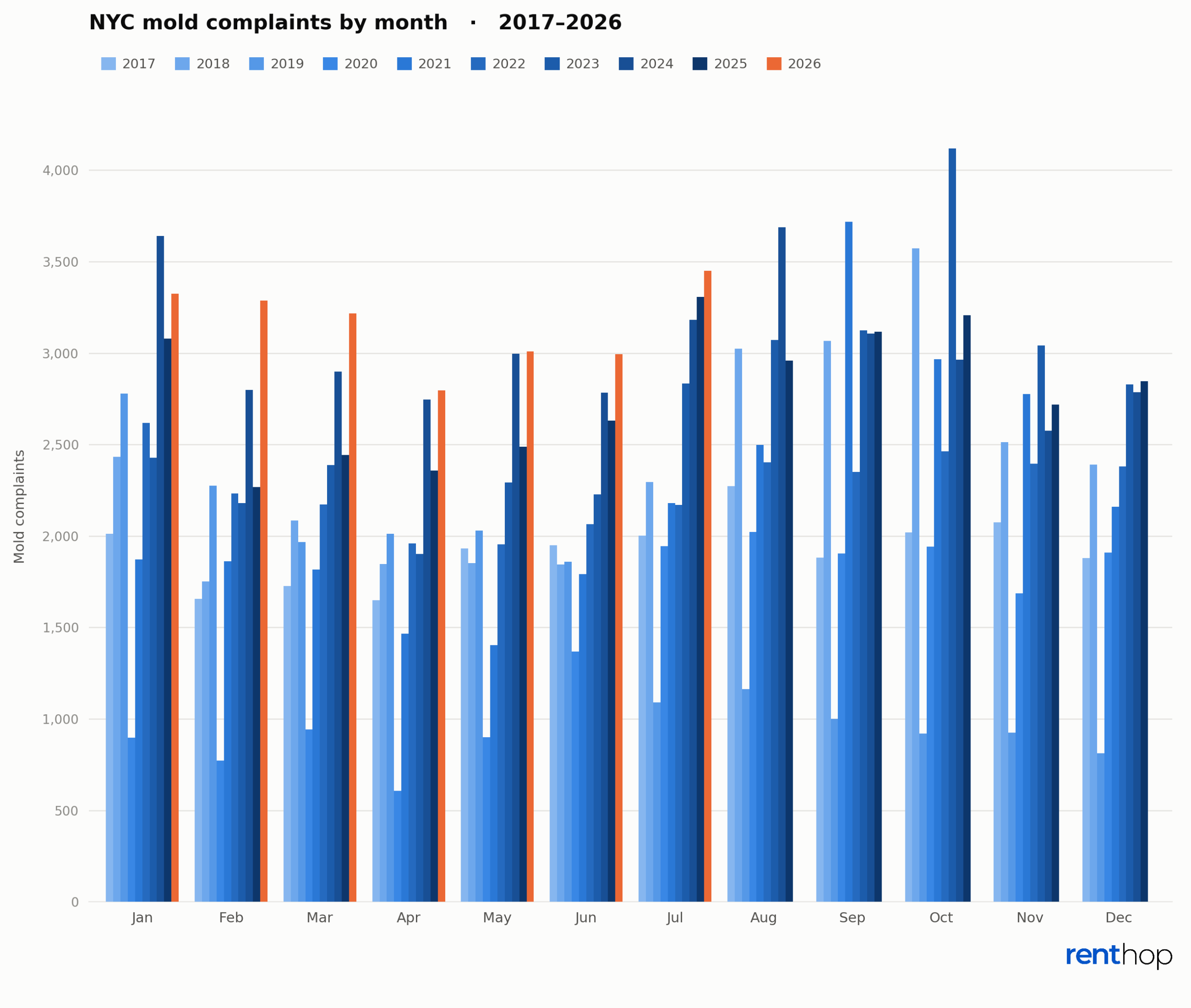
Renters complain more about mold in the later summer through early winter months. During the spring and early summer, complaints decrease. Peak hurricane season, which spans from mid-August to mid-October, can impact mold complaints, as the region receives a higher concentration of rainfall, giving more room for mold to grow. Late summer in New York City is also hot, and apartments without central air conditioning may be more prone to mold. The likelihood of mold increases in humid areas without windows, like the bathroom.
Tropical Storm Ophelia Impact
Mold complaints reached their highest level on record in October 2023. The big factor that contributed is Tropical Storm Ophelia. The effects of the storm were not realized until the next month. On September 17th, Tropical Storm Ophelia swept through the city, but the effects had a lasting impact. For example, The New York Mets postponed their game against the Miami Marlins, even though the storm had happened 4 days earlier. October 2023 remains the month with the highest number of mold complaints on record.
2025 Was an Improvement for NYC’s Mold
2024 witnessed the highest volume of mold complaints per RentHop’s record, with 36,178 complaints across the five boroughs. 2025 saw a decrease in all of the boroughs, except Manhattan. In 2025, there were 33,422 complaints reported, which is a 7.62% decrease from the record high 2024. Additionally, 7 neighborhoods received at least 50% more mold complaints in 2025 than in 2024.
2026 Mold Complaints in the Making
So far this year, 2026 has more mold complaints than 2025. 2026 has had more mold complaints than 2025 for every month from January through July, and is also ahead of 2024’s pace for the same period.
Humidity may play a factor in the final 2026 complaints. Humidity levels in July haven’t been this high since 2021. This could lead to the end of summer having more moisture in the air that may get trapped in homes.
Renter Self-Advocacy
Mold complaints may continue to increase, partially due to changing renter attitudes and access to online information. New York City offers an online portal to submit mold complaints, and as more renters learn about the ease of submitting complaints, they may be more likely to do so when they would have remained quiet in years past. Renters also post about mold on social media, which informs their peers, also increasing the likelihood of renters submitting complaints.
Furthermore, the average rent in New York City continues to rise. As renters receive renewal notices for higher rents and face an expensive market, they may be less willing to put up with unsafe housing conditions. Renters who received COVID-19 deals for their apartments may no longer have a cheap rent, meaning they will escalate to 311 if their landlord does not respond.
Why Should Renters Care About Mold Complaints?
Mold exposure causes various symptoms, and living in a mold-infested apartment will prolong and intensify the effects. Renters with mold allergies or asthma can suffer more intense reactions to mold. Overall, those living in mold-infested apartments are more likely to suffer from wheezing, red or itchy eyes, a stuffy nose, and skin irritation, according to the Center for Disease Control (CDC). In severe cases, renters can develop fungal infections that require diagnosis and treatment by a medical professional.
To limit the risk of symptoms and infections, renters should avoid living in apartments with mold and promptly report any appearances to their property manager. Renters who plan to move to a neighborhood with high mold complaints should take extra precautions to investigate their apartment’s history of mold.
How to Spot Mold During an Apartment Tour
It’s important that you recognize the signs of mold during apartment showings. Some common signs of mold include:
- Gray, green, yellow, black, or orange patches
- Furry, slimy, or powdery areas
- Musty, earthy, or stale smells
Mold grows more easily in wet and damp places. If the bathroom does not have a window or if the apartment does not have strong ventilation, it is easier for mold to grow. Mold may appear on fabric, wallpaper glue, wood, and other surfaces. Warm temperatures and high humidity increase the likelihood of mold.
If you’re touring an apartment and believe you see mold, ask the agent or person showing the unit for further information. Should they identify mold in the unit, the owner should take proper steps to remove the mold before your move-in date. However, a vacant apartment should not have enough moisture to grow mold, and renters could also consider not leasing the unit if there is already an issue with mold.
What to Do When You Find Mold in Your Apartment?
If you discover mold in your personal apartment or throughout the building, you should contact your landlord or property manager to address the issue. Some mold spots may be safe and easy to clean on your own, but documenting the incident to building owners can help establish a timeline if the problem persists or worsens. Landlords are responsible for properly cleaning mold and improving any situations that continue to increase the presence of mold in the apartment. Your building manager may send someone to come and clean the mold and address the root of the problem, like a leaky pipe.
If your landlord or property manager does not address the mold, call 311 to report the issue or file a complaint online with the Department of Housing Preservation and Development (HPD). HPD will attempt to contact your building manager and potentially send a uniformed Code Enforcement inspector to review the situation and check for any additional violations. They will ticket the building owner for violations. If the owner does not rectify the problem within the designated period of time, you can initiate legal action against the owner in Housing Court.
Questions? Email press@renthop.com


