The post 2026 On Pace To Be Moldier than 2025 appeared first on Real Estate Data & Research.
]]>Mold raises health concerns, such as headaches and itchy eyes, but in more serious cases, it can cause fungal infections that require diagnosis and treatment. Mold also damages property, as repeated instances indicate excessive moisture that could develop into unsafe structural issues. To find out how much New Yorkers combat mold issues, RentHop looked into 311 complaints about mold from 2017 through August 11, 2026. The results show that more renters have filed complaints about mold in recent years. Continue reading to learn if you live in an area with a high volume of mold complaints.
Key Findings
- The Bronx remains New York City’s moldiest borough, with 218.7 complaints per 10,000 residents.
- Flatbush receives the most mold complaints, averaging 642.8 complaints per year. An increase from last year of 19.2 from last year’s report.
- October 2023, specifically in Brooklyn, received the most mold complaints on record since 2017, coinciding with delayed effects of Tropical Storm Ophelia.
- Month-over-month, renters complain most about mold at the beginning of the year or in the late summer.
- Monthly complaints in 2026 are higher than 2025 at this point last year. This has been a higher humidity year than previous.
Mold Complaints by NYC Borough
The above chart breaks down the number of mold complaints by year by borough. The Bronx has received the most complaints yearly since 2019. Last year, the borough received 11,444 complaints, or 269.2 reports per 10,000 renter-occupied units, making it the moldiest borough in New York City.
Brooklyn is also a hot spot for mold complaints, where renters submitted 311 reports 10,046 last year. That’s 135.3 complaints for every 10,000 renters. Flatbush received the most mold complaints out of any neighborhood last year, and has already had 503 complaints in 2026.
With the exception of Manhattan, mold complaints decreased in 2025. With an increase in 311 awareness thanks to the mayor’s efforts, we are seeing more reported complaints this year compared to this time last year.
Mold Complaints, Mapped Out By NYC Neighborhoods
The interactive map below breaks down mold complaints to NYC 311 by neighborhood and highlights the top reported addresses. To fairly rank each neighborhood, we used raw complaint count from 2017 to 2026 by the total number of renter-occupied units. The darker the shade, the more complaints per 10,000 renter-occupied units. We also included median one-bedroom rents by neighborhood as a reference point for renters.
The map highlights the higher concentration of mold complaints throughout the Bronx and parts of Brooklyn. Renters also frequently complained about mold throughout Upper Manhattan.
The Moldiest Neighborhoods in New York
- Flatbush, Brooklyn: 457 complaints in 2025, 642.8/year
- Harlem (North), Manhattan: 566 complaints in 2025, 633.7/year
- Concourse-Concourse Village, Bronx: 421 complaints in 2025, 608.3/year
- Crown Heights (North), Brooklyn: 390 complaints in 2025, 566.2/year
- Washington Heights, Manhattan: 395 complaints in 2025, 529.6/year
The Mold Problem Is Getting Worse In These Neighborhoods
- Queensboro Hill, Queens: 3 complaints in 2025 (+366.7%)
- East Flushing, Queens: 9 complaints in 2025 (+266.7%)
- Douglaston-Little Neck, Queens: 3 complaints in 2025 (+266.7%)
- Stuyvesant Town-Peter Cooper Village, Manhattan: 9 complaints in 2025 (+222.2%)
- Howard Beach-Lindenwood, Queens: 10 complaints in 2025 (+180%)
Addresses with the Most Mold Complaints in NYC
- 89-29 163 Street, Queens: 50 complaints in 2025, 45 complaints in 2026
- 20 Richman Plaza, Bronx: 50 complaints in 2025, 20 complaints in 2026
- 772 East 168 Street, Bronx: 47 complaints in 2025, 15 complaints in 2026
- 530 East 169 Street, Bronx: 41 complaints in 2025, 54 complaints in 2026
- 107 East 126 Street, Manhattan: 41 complaints in 2025, 28 complaints in 2026
New York City Has Gotten Moldier In Recent Years
The following chart breaks down mold complaints from 2017 through 2026 by month to highlight seasonal trends.
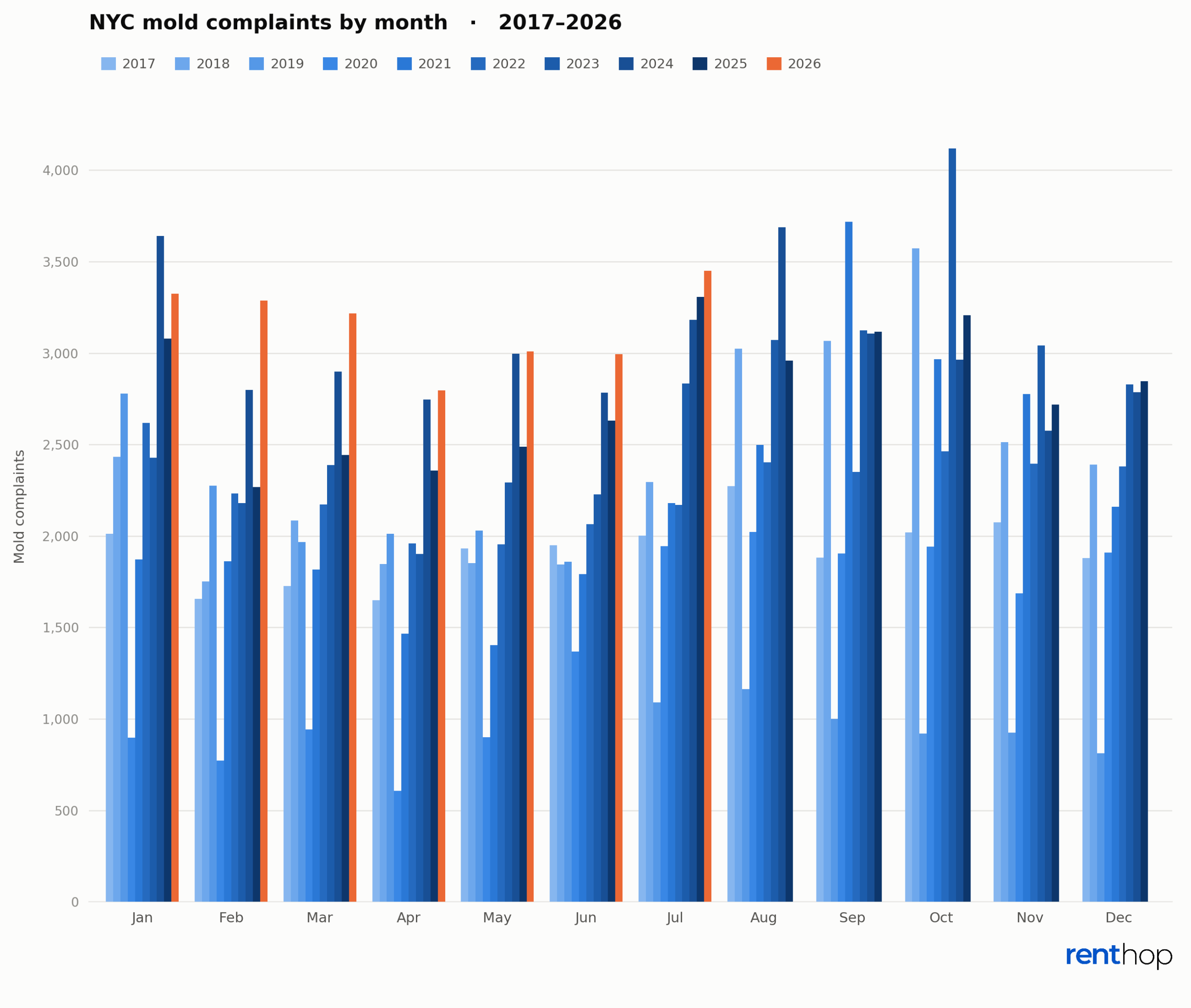
Renters complain more about mold in the later summer through early winter months. During the spring and early summer, complaints decrease. Peak hurricane season, which spans from mid-August to mid-October, can impact mold complaints, as the region receives a higher concentration of rainfall, giving more room for mold to grow. Late summer in New York City is also hot, and apartments without central air conditioning may be more prone to mold. The likelihood of mold increases in humid areas without windows, like the bathroom.
Tropical Storm Ophelia Impact
Mold complaints reached their highest level on record in October 2023. The big factor that contributed is Tropical Storm Ophelia. The effects of the storm were not realized until the next month. On September 17th, Tropical Storm Ophelia swept through the city, but the effects had a lasting impact. For example, The New York Mets postponed their game against the Miami Marlins, even though the storm had happened 4 days earlier. October 2023 remains the month with the highest number of mold complaints on record.
2025 Was an Improvement for NYC’s Mold
2024 witnessed the highest volume of mold complaints per RentHop’s record, with 36,178 complaints across the five boroughs. 2025 saw a decrease in all of the boroughs, except Manhattan. In 2025, there were 33,422 complaints reported, which is a 7.62% decrease from the record high 2024. Additionally, 7 neighborhoods received at least 50% more mold complaints in 2025 than in 2024.
2026 Mold Complaints in the Making
So far this year, 2026 has more mold complaints than 2025. 2026 has had more mold complaints than 2025 for every month from January through July, and is also ahead of 2024’s pace for the same period.
Humidity may play a factor in the final 2026 complaints. Humidity levels in July haven’t been this high since 2021. This could lead to the end of summer having more moisture in the air that may get trapped in homes.
Renter Self-Advocacy
Mold complaints may continue to increase, partially due to changing renter attitudes and access to online information. New York City offers an online portal to submit mold complaints, and as more renters learn about the ease of submitting complaints, they may be more likely to do so when they would have remained quiet in years past. Renters also post about mold on social media, which informs their peers, also increasing the likelihood of renters submitting complaints.
Furthermore, the average rent in New York City continues to rise. As renters receive renewal notices for higher rents and face an expensive market, they may be less willing to put up with unsafe housing conditions. Renters who received COVID-19 deals for their apartments may no longer have a cheap rent, meaning they will escalate to 311 if their landlord does not respond.
Why Should Renters Care About Mold Complaints?
Mold exposure causes various symptoms, and living in a mold-infested apartment will prolong and intensify the effects. Renters with mold allergies or asthma can suffer more intense reactions to mold. Overall, those living in mold-infested apartments are more likely to suffer from wheezing, red or itchy eyes, a stuffy nose, and skin irritation, according to the Center for Disease Control (CDC). In severe cases, renters can develop fungal infections that require diagnosis and treatment by a medical professional.
To limit the risk of symptoms and infections, renters should avoid living in apartments with mold and promptly report any appearances to their property manager. Renters who plan to move to a neighborhood with high mold complaints should take extra precautions to investigate their apartment’s history of mold.
How to Spot Mold During an Apartment Tour
It’s important that you recognize the signs of mold during apartment showings. Some common signs of mold include:
- Gray, green, yellow, black, or orange patches
- Furry, slimy, or powdery areas
- Musty, earthy, or stale smells
Mold grows more easily in wet and damp places. If the bathroom does not have a window or if the apartment does not have strong ventilation, it is easier for mold to grow. Mold may appear on fabric, wallpaper glue, wood, and other surfaces. Warm temperatures and high humidity increase the likelihood of mold.
If you’re touring an apartment and believe you see mold, ask the agent or person showing the unit for further information. Should they identify mold in the unit, the owner should take proper steps to remove the mold before your move-in date. However, a vacant apartment should not have enough moisture to grow mold, and renters could also consider not leasing the unit if there is already an issue with mold.
What to Do When You Find Mold in Your Apartment?
If you discover mold in your personal apartment or throughout the building, you should contact your landlord or property manager to address the issue. Some mold spots may be safe and easy to clean on your own, but documenting the incident to building owners can help establish a timeline if the problem persists or worsens. Landlords are responsible for properly cleaning mold and improving any situations that continue to increase the presence of mold in the apartment. Your building manager may send someone to come and clean the mold and address the root of the problem, like a leaky pipe.
If your landlord or property manager does not address the mold, call 311 to report the issue or file a complaint online with the Department of Housing Preservation and Development (HPD). HPD will attempt to contact your building manager and potentially send a uniformed Code Enforcement inspector to review the situation and check for any additional violations. They will ticket the building owner for violations. If the owner does not rectify the problem within the designated period of time, you can initiate legal action against the owner in Housing Court.
Questions? Email press@renthop.com
The post 2026 On Pace To Be Moldier than 2025 appeared first on Real Estate Data & Research.
]]>The post Tight Inventory Drove Up Rent Around Major Subway Stops appeared first on Real Estate Data & Research.
]]>It goes without saying that for New Yorkers, which subway stop you live close to matters. Proximity to the right trains means shorter commutes and more time spent doing what you love. But more importantly, choosing the right stop could potentially save you hundreds of dollars. How much can you save in 2026 by living one stop farther away from the city center? Let’s find out.
Key Findings
- City-wide, median one-bedroom rent rose 5.34% to $4,428 in July. Increases among two-bedroom units are more stark, at 10.67% year-over-year.
- Rental prices increased at 91% of subway stops this year, higher than the 87% in 2025.
- 23 subway stops experienced decreases in rent year over year.
- Franklin St (1-2) remains the most expensive subway stop, with a median one-bedroom rent reaching $6,191, 3.98% higher than last year.
- Supply crunch in Manhattan and parts of Brooklyn and Queens drove rents up significantly around certain stops, including 103rd St (Line 1), Eastern Pkwy – Bklyn Museum (2-3-4), and 14th St (Lines A-C-E).
2026 NYC Subway Median Rent Map with Annual Fluctuations
The map below shows the median one-bedroom rent at each subway stop, as well as year-over-year price fluctuations.
Median one-bedroom rents by subway stops remain high in Manhattan, specifically in neighborhoods known for luxury rentals, including TriBeCa, West Village, and Chelsea. Franklin St (Trains 1-2) remains the most expensive stop in NYC, at a whopping $6,191 per month for a one-bedroom. In Brooklyn, rents in Williamsburg, Greenpoint, Dumbo, and Brooklyn Heights are catching up with their city-center counterparts, with median one-bedroom rent reaching $4,840 at York St (F Train).
Turnover Freeze Drives Up Rents
Those who worry about being priced out of prime NYC locations are right to. Of the 473 stops we mapped, 91% posted higher one-bedroom rents than a year ago, up from 87% in 2025, with just 23 stops falling. At nine stops in ten, the rent went up.
The clearest sign of the freeze is what’s vanishing from the bottom: the number of stops with a $5,000+ one-bedroom more than doubled in a year, from 23 to 49. As lower-priced units get snapped up and held, the listings left behind skew higher. As moving means re-pricing to a near-record market, renters stay put to hold onto the rent they have, an instinct that only hardens with a stabilized-unit rent freeze in October 2026.
After 17 years of running RentHop, we’re seeing some of the largest YoY rental increases and it’s not at all surprising. The past year has brought significant regulatory and market-structure changes — if anything I’m curious why the gain was not more pronounced in certain areas. We’ll watch closely to see whether the trend carries into 2027 as landlords and brokers continue adapting.
— Lee Lin, CEO of RentHop
Median 1BR Rents at Major NYC Subway Hubs
Here’s what a one-bedroom runs near the busiest stops in the system. For context, the citywide median one-bedroom sits at $4,665 in 2026, and the Manhattan core hubs all clear it, while the Brooklyn and Queens ones land just under. Either way, you’re paying for the privilege of never being more than a transfer from anywhere.
Union Sq – 14 St
- N-Q-R-W Trains: $5,200, +2.97%
- 4-5-6-6 Express: $4,850, +3.19%
Times Square
- 1-2-3 Trains: $4,629, +2.98%
- N-Q-R-W: $4,797, +4.44%
Grand Central
- 4-5-6-6 Express Trains: $4,500, +2.86%
- 7-7 Express: $4,756, +8.09%
West 4th Street
- B-D-F-M Trains: $5,017, +7.88%
- A-C-E: $5,017, +6.85%
Herald Square
- B-D-F-M Trains: $4,878, +4.89%
- N-Q-R-W: $4,995, +7.53%
Fulton Street
- 2-3 Trains: $4,828, +2.82%
- 4-5: $4,799, +4.33%
- A-C: $4,800, +3.23%
- J-Z: $4,800, +3.58%
Jay St – Metro Tech
- A-C-F Trains: $4,345, +2.22%
Atlantic Ave – Barclays Center
- 2-3-4-5 Trains: $4,395, +2.21%
- B-Q: $4,395, +2.21%
- D-N-Q-R: $4,380, +2.46%
Broadway Junction
- J-Z Trains: $2,700, +0.19%
- A-C: $2,650, −0.84%
Jackson Heights – Roosevelt Av / 74 St – Broadway
- E-F-M-R Trains: $2,495, +6.17%
- 7 Train: $2,448, +2.19%
Columbus Circle is the rare hub that actually dipped this year, and 125th St stands alone as the one major interchange where a one-bedroom still starts with a 3. Everywhere else, convenience keeps getting more expensive.
Rents Spiked at These Stops
These are the stops where one-bedroom rents climbed hardest this year, double-digit jumps that ran several times the citywide pace. Notice where they sit: not the cheapest corners of the city, but the almost-affordable ones, right at the edge of the expensive core.
| Subway Stop | 2025 | 2026 | YoY |
|---|---|---|---|
| 103rd St (1) | $3,600 | $4,050 | +12.50% |
| Eastern Pkwy – Bklyn Museum (2-3-4) | $3,250 | $3,650 | +12.31% |
| 5th Ave – 53rd St (E-M) | $4,400 | $4,885 | +11.02% |
| 51st St (4-6) | $4,600 | $5,100 | +10.87% |
| 14th St (A-C-E) | $4,995 | $5,512 | +10.36% |
| Clinton – Washington Aves (A-C) | $3,625 | $3,995 | +10.21% |
| 8th Ave (L) | $4,995 | $5,500 | +10.11% |
| 18th St (1-2) | $4,998 | $5,500 | +10.06% |
| 72nd St (Q) | $4,000 | $4,400 | +10.00% |
Rents Decreased at These Stops
At 23 stops, one-bedroom rents actually fell year over year, a small club in a market this tight, but a real one. And there’s a pattern: most of the relief turned up in the northern Bronx, where a cluster of stops gave a little back.
| Subway Stop | 2025 | 2026 | YoY |
| Ocean Pkwy (Q) | $2,800 | $2,618 | −6.51% |
| W 8th St – NY Aquarium (F-Q) | $2,800 | $2,618 | −6.51% |
| Halsey St (L) | $3,195 | $3,000 | −6.10% |
| Middletown Rd (6) | $2,100 | $2,000 | −4.76% |
| Bronx Park East (2-5) | $2,100 | $2,000 | −4.76% |
| Bedford Park Blvd – Lehman College (4) | $2,000 | $1,925 | −3.75% |
| Bedford Park Blvd (B-D) | $1,995 | $1,925 | −3.51% |
| Pelham Pkwy (2-5) | $2,048 | $2,000 | −2.34% |
| Brooklyn College – Flatbush Ave (2-5) | $2,625 | $2,600 | −0.95% |
| 231st St (1) | $2,725 | $2,700 | −0.92% |
Turn your commute into extra cash at these stops
Remember the question from above, “how much can you save in 2026 by living just one stop away from the city center”? Check out the answers, and the savings might be bigger than you realize.
- Save $995 by moving from 68th St – Hunter College to 77th St ($3,895) on the 4-6-6 Express trains
- Save $900 by moving from Bedford Ave to Lorimer St ($4,500) on the L train
- Save $800 by moving from Bowery to Delancey – Essex Street ($3,995) on the J-Z trains
- Save $650 by moving from 96th St to Central Park North (110th St) ($3,400) on the 2-3 trains
- Save $600 by moving from Broadway – Lafayette St to Lower East Side – 2nd Ave ($4,000) on the B-D-F-M trains
- Save $514 by moving from Lafayette Ave to Clinton – Washington Aves ($3,995) on the A-C trains
Methodology
To calculate the median net effective rents for the map above, we used RentHop’s rental data for long-term, unfurnished one-bedroom apartments from April 1 through June 30, 2025 & 2026, MTA Lines and Stops data, and GIS data for subway stops compiled by CUNY – Baruch College and NYC Open Data. To get accurate prices near the subway stops, we looked at least 50 non-duplicated rental listings within 800 meters (0.5 miles) of a subway stop and then calculated the median rents. If there were less than 50 non-duplicated listings. If not, the radius from the stop was increased and the data were resampled to ensure enough unique listings were used when calculating the median.
.button1 {box-shadow: 0 0 0 0 rgba(0,0,0,0.2), 0 0 0 0 rgba(0,0,0,0.19);}
.button {background-color: #810303; border: none; color: #ffffff; padding: 5px 15px; text-align: center; text-decoration: none; display: inline-block; font-size: 14px; font-weight: bold; margin:4px 2px; cursor: pointer; -webkit-transition-duration: 0.4s; transition-duration: 0.4s;}
The post Tight Inventory Drove Up Rent Around Major Subway Stops appeared first on Real Estate Data & Research.
]]>The post Brooklyn Neighborhood Jumps to Top Spot in Heat Complaints appeared first on Real Estate Data & Research.
]]>Despite the NYC Heat Law, many landlords do not comply with heating regulations, resulting in many tenants reporting their buildings to 311. Each winter, RentHop analyzes the frequency of these calls throughout buildings, neighborhoods, and boroughs, finding that certain areas receive more heat complaints than others. Areas like Norwood (Bronx), Gerritsen Beach (Brooklyn), and Little Italy (Manhattan) continue to receive a high volume of heat complaints. The following describes where renters are more likely to be left out in the cold.
Key findings from this year’s report include:
- In total, 234,474 heat and hot water complaints were filed to 311 residents across New York City from December 1, 2025, to February 3, 2026, 11.24% more than last winter.
- After grouping complaints by day and address, we found 155,907 unique complaints, 9.93% more compared to the same period last year.
- Of the five boroughs in NYC, four received more heat complaints than last year, including the Bronx, Brooklyn, Manhattan, and Queens. [Section “Heat Complaints by Borough“]
- Some of the worst heat violation offenders include 1040B East 217 St (1223 complaints / 97 unique), 2800 Creston Avenue (1,025 complaints / 108 unique), and 707 East 242 Street (748 complaints / 101 unique) [Data Table]
Heat Complaints by Borough
The Bronx
- The Bronx remains the coldest borough, receiving 51,326 unique heat complaints this winter as of February 16.
- Norwood is the coldest neighborhood in the Bronx, with 2,351 unique complaints, or 1671.04 complaints/10k renter-occupied units. Complaints decreased by 8.58% from last year.
- 6 of the 10 coldest NYC buildings reside in the Bronx.
Brooklyn
- Brooklyn received 44,229 unique heat complaints, increasing by 14.85% from last year.
- Flatbush remains the coldest neighborhood in Brooklyn, with 11,846 unique complaints and 1490.90 complaints/10k renter-occupied units.
Manhattan
- Heat complaints are up 13.08% from last year during the same period, with residents filing 36,841 unique heat complaints.
- In the coldest neighborhood, Harlem, heat and hot water complaints are up 19.21% from last year.
Queens
- Queens received 21,876 unique heat complaints this year, up 6.9% from last year, the most of all boroughs.
- Flushing is the second coldest neighborhood in the borough, where complaints are up 57.04%.
Staten Island
- Renters in Staten Island have filed 1,635 unique complaints as of February 3, 2026, down 3.37% from last year.
- The neighborhood with the most complaints, St. George, has 736.25 unique heat complaints per 10k renter-occupied units this year.
When Does the Heat Season Start?
Landlords in New York City must provide heat for all of their tenants from October 1st through May 31st. This period is referred to as the “Heat Season.” Heating requirements include:
- Between 6:00 AM and 10:00 PM, if the outside temperature falls below 55 degrees, the inside temperature is required to be at least 68 degrees F
- Between 10:00 PM and 6:00 AM, if the inside temperature is required to be at least 62 degrees F, no outside temperature requirement
Many buildings in the city do not provide adequate heat for their residents, with some addresses receiving significant numbers of complaints throughout the Heat Season. Buildings like 31-35 Crescent Street in Queens and 2176 Tiebout Avenue in the Bronx received hundreds of complaints this year.
Surely, when tenants are suffering, they make dozens of complaints each day to 311. Therefore, to accurately measure the number of days a building goes without heat, RentHop grouped the heat/hot water complaints by address and created date. Complaints filed on the same day regarding the same building are considered one unique complaint. From December 1, 2025, the start of this Heat Season, to February 3, 2026, the city received 234,474 unique heat complaints, 11.24% higher than the total unique count of 210,780 in the same period last year.
Renters Suffer as Temperatures Drop Below Freezing
It is no surprise that when the temperature drops, renters are more likely to file a complaint, but by how much? We at RentHop visualized the correlation for you in Figure 1. As you can see, the recent cold waves have driven a surge in 311 calls”, with unique complaints shooting over 5,000 on January 24th, 25th, and 30th, when the lows in mid-teens. The volume of complaints 311 had to process soon dropped below 3000 as the temperature rose above freezing on February 3rd. With this year already

Mapping the 311 Heat Complaints by NYC Neighborhood
To fairly rank the neighborhoods, we further normalize the data by dividing the number of heat complaints by the number of renter-occupied units in a neighborhood retrieved via the 2021 American Community Survey (homeowners can control their heat and are therefore excluded from this study).
The map below illustrates how “cold” each NYC neighborhood is. The darker the shade, the more heat complaints per 10,000 renter-occupied units a neighborhood has seen this winter. Click on the neighborhood to learn more.
Neighborhoods in the Bronx received more heat complaints than the other boroughs. Out of the 20 coldest neighborhoods in New York City, 14, or 70%, are in the Bronx. Other areas of the city, like neighborhoods in Manhattan above Central Park and Central Brooklyn, receive frequent heat complaints as well.
These are the Coldest Neighborhoods in NYC
Figure 3 showcases the top 20 neighborhoods with the largest amount of normalized heat complaints this season, from December 1, 2025, to February 3, 2026. 17 of the 20 neighborhoods are located in The Bronx.
Gerritsen Beach took over first place this year, replacing Norwood. The neighborhood received 6333.33% more complaints than last year, with 3750 complaints per 10k renter-occupied units reported between December 1 and February 3, 2026. This sharp increase can be attributed to one specific address, 2265 Gerritsen Avenue. Overall, 17 out of the coldest 20 neighborhoods received more complaints this year than last year.
Little Italy remains Manhattan’s coldest neighborhood with 59.14% more complaints than last year. It’s worth noting that most buildings receiving complaints in Little Italy are older and smaller, built in the early 1900s and hosting fewer than sixteen residential units. As of February 3, the neighborhood had received 2,803.03 complaints per 10k renter-occupied units this heating season. Marble Hill ranks as the second coldest neighborhood in Manhattan, with a total of 2,083.82 unique complaints filed per 10k renter-occupied units, 43.78% worse than in the previous winter.

Winter Just Got Colder in These Neighborhoods
Figure 4 displays the neighborhoods with the greatest increase in heat complaints this year. Complaints in Gerritsen Beach, Brooklyn saw the highest percent increase. Meanwhile, renters in Staten Island saw two neighborhoods in the top 5 in complaint percentage increase. Grant City and Eltingville saw 357.14% and 176.92% increases, respectively.

Buildings with Frequent Heat Complaints
While some neighborhoods receive more complaints than others, certain buildings have a high amount of complaints as well. The following table displays the 100 buildings across the city with the highest number of heat complaints this year. If you’re looking to sign a lease, make sure to check your building against this list to ensure you’ll stay warm in the winter. You can further explore the data by sorting the data by column or doing a quick search using the search bar.
Buildings with Frequent Heat Complaints
While some neighborhoods receive more complaints than others, certain buildings have a high amount of complaints as well. The following table displays the 100 buildings across the city with the highest number of heat complaints this year. If you’re looking to sign a lease, make sure to check your building against this list to ensure you’ll stay warm in the winter. You can further explore the data by sorting the data by column or doing a quick search using the search bar.
The post Brooklyn Neighborhood Jumps to Top Spot in Heat Complaints appeared first on Real Estate Data & Research.
]]>The post RentHop Singles Index: 2026 appeared first on Real Estate Data & Research.
]]>Each year, RentHop updates the Singles Index to calculate the housing burden – the percentage of income a single renter has to allocate each month to rent a studio home – in the largest cities in the country. In our sixth annual edition, we also broke down the data to analyze the single renter burden by gender. Using the median nonfamily income and nonfamily household income by sex data released by the U.S. Census Bureau, we found that:
- New York, NY, remains the least affordable city for single renters. Single renters must spend 69.53% of their income to rent a studio apartment.
- New York is also the least affordable city for single women when breaking down the data by sex. Female renters must allocate 77.96% of their annual income vs. 60.71% for single men.
- Meanwhile, Wichita, KS, remains the most affordable city. With a median studio rent of $600 per month, a single renter only needs to spend 18.03% of their income on rent.
- Single female renters in Miami, FL, would have to spend 1.71 times more of their income to live alone than men. For male renters, the monthly burden is 42.16%, whereas for women, it is 71.96% of their income.
- While California has some of the smallest gender wage gaps in the country, San Jose has the third-highest housing cost gap among all the cities. Single female renters would have to spend 33.73% of their annual income on a studio home, 1.45x higher more than their male counterparts.

Least Affordable Cities for Singles
1. New York, NY
New York City is yet again the most expensive city for singles, where the median rent for a studio apartment is a whopping $3,505. This city became more expensive for singles this year, where the cost of rent increased at a greater rate than wages. Single men have the advantage in New York City, where their median income outpaces women by over $15,000.
2. Miami, FL
Miami rent increased the most out of the five least affordable cities for renters, maintaining its spot as the second least friendly city. The median studio rent increased by 5.29% since last year, and singles can expect to spend 53.32% of their income on rent.
3. Detroit, MI
It’s unaffordable to be single in Detroit, where lower wages mean singles spend a high premium to live alone. The median rent for a studio apartment is $900 this year, but singles with a median income of $27,930 end up spending 38.67% of their income on housing. Detroit is the only city of the top five to have the median income go down, so residents bear a bigger burden than in the past.
4. Boston, MA
Boston’s rent remained steady at $2,350 year over year. Renters still spend 34.97% of their income on housing. In this city, there is a significant difference in affordability between the genders, where single women earn $73,957 and spend 38.13% toward renting, but single men earn $88,924 and spend 31.71% on rent.
5. Philadelphia, PA
Philadelphia moved up to the fifth least affordable city for singles this year. With a median studio rent of $1,295, singles in this city can expect to spend 33.77% of their income on rent yearly. Single men also have the advantage in this city, where they outearn women by $11,720, easing their housing costs.
Most Affordable Cities for Singles
1. Wichita, KS
Wichita’s low housing costs make it affordable for single renters looking to live on their own. Wichita has the lowest median rent of all the cities at $600, and singles earn a median income of $39,933. Therefore, they will only have to direct 18.03% of their income toward housing, which leaves plenty of their funds available for dating activities.
2. Seattle, WA
Seattle moved up to the 2nd most affordable city for singles. The city boasts the fourth-highest median of all cities, where singles earn $88,640 yearly. While the median studio rent is $1,450, singles only direct 19.63% of their earnings toward renting costs.
3. Colorado Springs, CO
Rent became less expensive in Colorado Springs this year, and the city managed to move in the rankings to become the third most affordable city for singles. Singles earning a median income of $57,796 can expect to spend 19.70% of it on their monthly rent. The rent decreased to $949, both single men and women pay under the 30% housing budget recommendation, leaving money for other activities.
4. Columbus, OH
Columbus is also an appealing city for singles because of its housing affordability. Single men in this city earn $53,692 and spend 19% of it on housing, and single women earn $48,819 then spend 20.89% on rent. Rent is more affordable in this city, where renters spend a median of $850 for a studio apartment.
5. Austin, TX
Austin, TX makes its way to be the fifth most affordable city for singles. Median studio rent decreased by 5.52% since last year, and increased income by 3.30%. The median studio rent is $1,199 this year, but renters will only spend 20.29% of their income on housing costs.
Housing Burden Among Singles, Broken Down by Gender
Many single renters feel the effects of strenuous economic conditions when considering the gender wage gap. According to Pew Research, the gap slightly decreased in 2025 – for every dollar men earned, women earned only 85 cents. Translating to housing, the gap means it is harder for women to buy or even rent a home independently.
Our analysis indicates that across the top 50 U.S. cities, single women, on average, would have to spend 1.22 times more of their annual income on renting a studio than their male counterparts. In numerous cities, renting is unaffordable for single men and women, such as Detroit, MI, Baltimore, MD, and Oakland, CA. However, we see a different story when ranking the cities by the housing burden gap.
Miami is the Most Unfriendly City for Single Women Renters
The list below highlights the 10 U.S. cities with the worst housing burden gap among single renters. In Miami, FL, single women would have to spend 71.96% of their income on housing if they wished to rent a studio home and live alone, over the commonly known 30% standard for housing affordability. Meanwhile, single men would only need to spend 42.16% of their income.

While California has a smaller gender pay gap at the state level compared to many other states, three of its cities, San Jose, Long Beach, and Bakersfield, are ranked as some of the most unfriendly cities for single women to rent a studio. In San Jose, the median studio rent is $2,095. This means that a single female renter making the median nonfamily household income of $74,529 would have to spend 33.73% of their annual income on rent. Single men, on the other hand, would spend only 23.29% of their income on a studio home with a median income of $107,923.
New York City, while unaffordable for both men and women, puts a larger burden on single women trying to rent a studio apartment. Women with a median income of $53,953 will need to spend 77.96% monthly to afford a studio, whereas men will spend 60.71% of their income on rent.
Methodology
The RentHop Singles Index analyzes both proprietary and ACS Census data to provide a snapshot of housing affordability for single-income households across the 50 most populous cities in the country. To compile our housing price data, we pulled every listing for a studio apartment advertised on RentHop from January 1 to December 31, 2025. In theory, a single person can rent a larger space, but we chose this unit type to represent the minimum space in which one can live alone.
To calculate the index, the following statistics were used:
- Median non-family household income from the U.S. Census
- Median advertised prices for the “studio” unit type via RentHop data
- Year-over-year price changes for the “studio” unit type based on RentHop data
- Population count by city from the U.S. Census
The income factor reflects median nonfamily household income. Median values are less likely to be skewed by outliers and, therefore, more representative of the income distribution and what typical single Americans make.
For more information on our methodology or to contact our data team, please email press@renthop.com.
Full Data
You can learn more about our index this year using the two interactive tables below. The first table includes overall rankings and housing burden, and the second one further breaks down the data by gender.
Housing Burden by Gender
The post RentHop Singles Index: 2026 appeared first on Real Estate Data & Research.
]]>The post The Most Expensive Rental Zip Codes in 2025 appeared first on Real Estate Data & Research.
]]>Each year, RentHop finds the 100 most expensive zip codes across the country and ranks them from most to least expensive based on the median two-bedroom rent. In the past, our annual index included zip codes with luxury seasonal rentals, such as Snowmass, Aspen, and the Hamptons. To reflect the true cost renters face, we now exclude furnished and seasonal rentals. This year, we analyzed over 2.6 million rental listings to find the most expensive rental zip codes in 2025. Are you renting in one of these pricey areas?
Key Findings
- 10007 in New York, NY, is the most expensive zip code in the country. The median two-bedroom has a monthly rent of $9,489 with one-bedroom rent coming in at $6,500.
- The most expensive zip codes reside in nine states across the country. 46 reside in New York, 35 in California, and 7 in Massachusetts.
- One zip code in Washington, DC made the Top 100 list this year. 20037 is the 97th most expensive zip code in the country, with a two-bedroom median rent of $4,500 per month.
- New York City remains the most expensive city for renters, with 46 zip codes across the metro area on the list. Tribeca ($9,489), Battery Park City ($8,850), Upper West Side, and Riverside Park South ($8,560) are some of the most expensive zip codes in the country.
- Los Angeles, CA has 23 of the most expensive zip codes. The city is still the second most expensive for renters, with the 90067 zip code on the Top 10 List. The median two-bedroom rent here increased to $8,325 this year.
- Boston is the third most expensive city, with seven zip codes on the list. These zip codes are in sought-after neighborhoods like Downtown Boston (02110).
10 Most Expensive Rental Zip Codes in the U.S.

1. New York, NY (10007)
10007 in New York, NY, is the most expensive rental zip code in America. The two-bedroom rent goes for $9,489 a month this year, with median one-bedroom rent sitting at $6,500. TriBeCa has converted loft spaces that showcase modern luxury with neighborhood charm.
2. New York, NY (10282)
The second most expensive zip code in the country is 10282 in New York, NY. The waterfront location of Battery Park City is highly sought after. This year, the median two-bedroom rent hit $8,850, and the median one-bedroom rent is $6,500.
3. New York, NY (10069)
10069 in New York, NY, gives you proximity to Central Park and an unbeatable view of the Hudson River. This year, it’s the third most expensive zip code nationwide, where the one-bedroom rent is $4,950 and the two-bedroom rent is $8,560.
4. Boston, MA (02110)
02110 in Boston, MA, covers Downtown, while also being close to the popular North End. The median two-bedroom rent is $8,498.
5. Southlake, TX (76092)
Coming in fifth on our list is 76092 in Southlake, TX, which resides between Dallas and Fort Worth. Renters can expect to spend a whopping $8,480 monthly on a two-bedroom apartment in this area.
6. Los Angeles, CA (90067)
90067 in Los Angeles remains in the Top 10. The median two-bedroom is $8,325 as the Century City neighborhood continues to appeal to renters in the area. Located near Beverly Hills and West L.A., the area includes plenty of expensive properties.
7. New York, NY (10023)
10023 in New York, NY, made its way onto the Top 10 List this year, coming in seventh place. The median two-bedroom goes for $8,300 as the Upper West Side neighborhood continues to appeal to renters in the area. Located near Central Park and the Lincoln Center, the area includes plenty of expensive properties.
8. New York, NY (10001)
The New York, NY zip code of 10001 is the eighth most expensive spot this year, with a median two-bedroom rent of $8,200. This Chelsea neighborhood provides its residents quick access to Penn Station and Madison Square Garden.
9. New York, NY (10013)
With a median two-bedroom rent of $7,795 a month, 10013 in New York, NY, is the ninth most expensive rental zip code of the year.. The zip code encompasses the TriBeCa and SoHo area, which include many attractions including Washington Square Park and the 9/11 Memorial.
10. New York, NY (10011)
10011, yet another zip code in Manhattan, New York, rounded out our Top 10 list this year. Chelsea serves as a prime location near The Village and Meatpacking District. The median two-bedroom rent in this zip code is $7,795.
Most Expensive Zip Codes Come From Only 9 States

This year, the 100 most expensive zip codes come from eight states and Washington, DC. New York has the highest number of expensive zip codes, with 46. Following New York, California comes in second with 35 zip codes, followed by Massachusetts with seven zip codes. New Jersey has four. Connecticut, Florida, and Texas all have two. Nevada and Washington, DC both have 1 zip code in the top 100.
The concentration spread out includes Washington, DC. 20037 in Washington, DC, has a median two-bedroom rent of $4,500 this year due to higher demand and constricted inventory.
New York City is the Most Expensive City for Renters

New York City is still the most expensive city nationwide for renters, with seven zip codes in the Top Ten List this year. Overall, 43 of the most expensive 100 zip codes reside in New York. Around 75%, or 32, of those zip codes reside in Manhattan, which has notoriously expensive real estate across most neighborhoods.
Brooklyn remains expensive for renters and has nine zip codes on the list. Many of the zip codes reside in sought-after northwest neighborhoods like Williamsburg, Greenpoint, and Boerum Hill. In this area, renters can expect to spend at least $5,000 on a two-bedroom apartment. Popular new builds and renovated townhouses with outdoor space continue to attract renters with Manhattan budgets, further driving up prices.
Queens has two zip codes on the list this year, 11109 and 11101. Hunters Point, 11109, resides on the water and boasts modern units in buildings with plenty of amenities. Renters in this area can quickly commute into Manhattan, making these units highly sought after. The median two-bedroom rent in this zip code decreased slightly to $6,110 this year.
Los Angeles Rents Are Still Pricey

23 of the most expensive zip codes reside in Los Angeles this year. The rental market has not significantly cooled off year over year, and Los Angeles was no exception.
The city’s expensive zip codes include areas like 90265 (Malibu) with a median two-bedroom rent of $6,220. The popular Beverly Hills zip code of 90210 also made the rankings this year. The median two-bedroom rent in this zip code is $5,650.
Rents Remain High in Boston
Boston is still one of the most expensive cities for renters. The expensive zip codes reside in popular areas like the Back Bay, also one of the country’s most costly zip codes for buying property. Residents in this area can expect to pay $5,500 for a monthly two-bedroom apartment. Other zip codes include 02210 in South Boston and 02108 in Beacon Hill.
Methodology
This RentHop report showcases the most expensive zip codes in the U.S. for renting a home. Data was collected from RentHop’s national rental database, which included over 2.6 million active rental listings during the period between January 1, 2025, and November 15, 2025.
To produce the ranking, the median rent for a two-bedroom and one-bedroom unit was found for every zip code in the country. Results were sorted by two-bedroom price from most expensive to least, as this unit type was the most common across all zip codes. In the result of a tie, a zip code’s one-bedroom rent was used as a tie-break.
This report includes only residential rental listings. Any listings classified as sales or commercial rentals were excluded from the analysis. We also removed any seasonal and short-term only rentals to factor in the inflated prices in certain zip codes with a high volume of vacation home rental supply. This allows our index to better reflect what an average American renter has to pay for a long-term rental in those zip codes. Any listings with invalid zip codes, including single-building zips in New York City, were excluded, as well.
For more information on our methodology or to contact our data team, please email press@renthop.com.
Full Data
The post The Most Expensive Rental Zip Codes in 2025 appeared first on Real Estate Data & Research.
]]>