



When you work with a tenant’s agent, you may pay a broker’s fee in addition to the first month’s rent and security deposit. Most agents work solely on commission; their broker fee is their source of income. The broker’s fee is the agent’s money for their services, including showing the apartment and then handling and guiding renters through the application process. Most New York City agents charge between one month’s rent and 15% of the annual rent for the broker’s fee. As of June 11, 2025, the party hiring the real estate agent must pay their broker’s fee. The broker fee falls either on the property owner or the tenant.
When working with an agent who charges a broker’s fee, the agent will ask you to sign two forms before showing an apartment:
- Fee Agreement: This form protects an agent and ensures payment (either from the renter or the landlord) if you successfully sign the lease.
- Agency’s Disclosure Form: This document clarifies who the agent represents, either the landlord or the tenant.
Neither form binds you to lease the apartment. You can sign the form and then decide you don’t want to apply for that unit. The documents designate that the agent will receive their commission if you do rent that apartment. You can ask for a copy of the agreements to keep for your records. Many agents now send these forms electronically before a showing, so you will receive the executed digital copy in your email.
Landlord vs tenant agent
To understand the way that broker fees and no-fee listings impact renters, it’s first crucial to know the difference between a landlord’s agent and a tenant’s agent. The landlord’s agent is a real estate agent whom the landlord hires to find a qualified tenant for the apartment. The landlord and real estate agent have a relationship, and as of June 11, 2025, the landlord pays the agent a broker fee.
A tenant agent is a real estate agent whom a prospective tenant hires to help them find an apartment. Tenants may be too busy to search for apartments, or may not yet live in the area they’re looking to move to. The tenant’s agent has expertise in the local market and can find a great apartment for the renter. Tenant’s agents will charge tenants a broker fee for their services.
What is a “no-fee” listing?
A no-fee apartment is a unit where the renter doesn’t pay a broker’s fee. In this scenario, the landlord or management company pays the broker’s fee to the agent directly, which is how the agent makes their income if you sign a lease. When you acquire the apartment, you will only pay the first month’s rent and the security deposit.
Listings put online by the owner of a building do not have a broker’s fee, as there will not be an agent involved in the process. Therefore, you can also use the “by owner” filter to find listings where you do not have to pay a broker’s fee.
How to negotiate a listing with a fee
If you hire a real estate agent to represent you as the tenant during your apartment search, they will likely charge you a broker’s fee. The agent represents you and not the landlord.
You may be able to negotiate the amount of the broker’s fee. While it is unlikely that an agent charging a fee will agree to get rid of the fee altogether, there may still be flexibility in terms of the amount. An agent charging a 15% broker’s fee may negotiate down to 12%, 8%, or one month’s rent. You can follow these tips to try to negotiate:
- Prove that you’re an informed renter. Continue reading through the rest of this guide to learn about the entire rental process. If you can prove that you know your roles and that you’re knowledgeable and prepared, an agent may be more motivated to lower their fee.
- Prepare all paperwork ahead of time. An agent is more inclined to work with a renter when they know that the renter can submit an application right away. If you can submit an application right after viewing a unit you like, you increase the odds of getting accepted and signing a lease, meaning the agent increases their chances of closing the deal and earning their commission. You can use your level of preparedness as a negotiating tactic to argue that you will save the agent time and effort during the application process and make them quick and easy money.
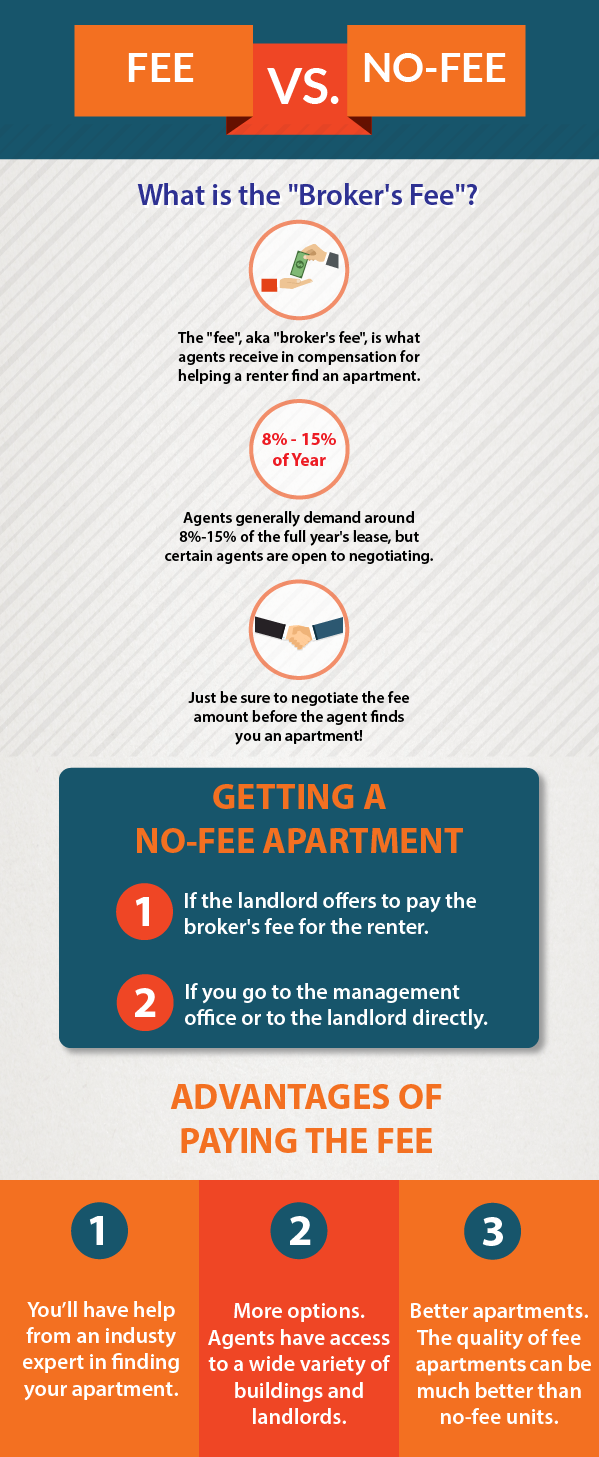
Difference between no-fee vs. fee
In New York City, renters can either search for no-fee listings or work directly with a real estate agent whose services they hire. When a landlord hires a real estate agent to advertise the listing and find them a tenant, the landlord pays the broker fee, making the listing “no-fee.”
If a renter approaches a real estate agent about their services, the agent may charge the renter a broker fee.
Therefore, a no-fee listing means the tenant will secure the apartment with their first month of rent, a security deposit, and an application fee. However, tenants eventually end up paying the broker fee over the course of their lease. Landlords who pay the broker’s fee themselves may bake that cost into the overall rental price of the unit.
Therefore, a renter’s decision on whether to hire a tenant agent or seek a no-fee listing can come down to their personal preferences and financial timeline. A renter who values the services that a tenant agent can provide and doesn’t mind the higher upfront fees may hire a tenant agent and pay the broker’s fee. Another renter may find a no-fee listing to lower the initial cost of signing for the apartment, knowing that they can afford their monthly rental payment down the line.
Additional discounts and concessions
While you may end up paying a broker’s fee, there are other opportunities available for saving money. Sometimes, landlords looking to quickly rent a unit may offer a rental concession, where they decrease the amount of money a renter pays over the duration of their lease term. A concession may include a month or two of free rent on a twelve or twenty-four-month lease. It is also important to note that some landlords may offer concessions, but in turn increase the monthly rental price, negating the deal and simply using the move as an appealing marketing tactic.
How many agents should I work with?
If you decide to work with an agent, you may contact several agents about their services. Some agents may only work with a few neighborhoods; therefore, you may need to work with multiple agents to cover all the apartments that you are interested in viewing. It’s possible that you may find an agent who can show you a wide variety of listings. Everyone has their own experience, and some may successfully rent the first apartment they look at with one agent, while others may meet with several agents before signing a lease. Check out RentHop’s Elite Agent page to find experienced agents to work with.
No matter what you decide to do, you should be aware of the following:
- You can work with as many agents as you would like. However, if you signed multiple agency disclosure forms for the same apartment with different agents, you may have to pay each agent’s broker’s fee. For example, if Agent A shows you an apartment and you sign their disclosure forms, then decide to view that same apartment a week later with Agent B and sign their disclosure forms, you will have to pay the broker’s fee to Agents A and B if they rent the apartment. This occasion is rare, but you should still be mindful of who you view each apartment with.
- Sometimes it’s good to try out multiple agents. If you feel uncomfortable with an agent for any reason, reach out to another agent at their brokerage to find someone who works best for you.
- If you plan to use the help of multiple agents, let those agents know. This will open lines of communication, and you can tell an agent if you’ve already seen a unit or ones in the area that you did not like, helping each agent find more properties that you want to view.


 Your Privacy Choices


